A gray outdoor HVAC condenser unit mounted on a concrete pad in the front yard of a two-story suburban house.

Heat Pump Repair in Myrtle Beach, SC

Tell us about the job

Takes about a minute. No obligation.

RepairHeat PumpHorry County, SC
Step 1 of 2

What ZIP code is the job in?

What the age and history tell you

A heat pump that's needed a few service calls over the years but has otherwise run fine is usually worth repairing again. One that keeps coming back for the same problem, like a failing capacitor or a reversing valve that sticks, is telling you it's wearing out as a whole, not just in that one part. The compressor matters most. If it's starting to go, the rest of the unit rarely outlasts it by much.


What a bad repair call looks like

The warning sign isn't the price of any one fix. It's a system that needs a refrigerant charge topped off every season, or one where the board or motor fails again within a year of being replaced. That pattern means the unit is failing faster than parts can keep up with it. At that point each repair is buying less time than the last one did.

5 months
November through March, your system heats
5 months
May through September, it cools
37°F
the average winter night it heats against
89°F
the average summer afternoon it cools against
Isometric cutaway illustration of a single-story house with a dark gabled roof, showing interior rooms with ductwork leading to an indoor air handler and an outdoor condenser unit connected by lines on the ground outside.
Your system heats November through March and cools May through September.

NOAA nClimDiv, 1991–2020 normals

Half the homes in Horry County were built in 1999 or later.

A heat pump installed with a house that age has likely got years of service left in it, which is a good reason to repair it.

Wind and hail come through Horry County a lot, and your heat pump takes the hit

111 damaging wind events from 2015 to 2024
49 hail events from 2015 to 2024
Power costs 14.23 cents a kWh statewide

If your heat pump has been acting up after a storm, that's worth mentioning to the contractor before they even look at it. Wind can knock the outdoor unit out of alignment or loosen a line that was fine the week before. Hail dents the cabinet and can bend the fins on the coil, and bent fins choke off airflow the unit needs to work right. A tech checking a unit after a storm is looking for different things than one checking a unit that just stopped cooling on a calm day, so telling them what the weather's been doing helps them find the actual problem faster. Get it looked at instead of waiting to see if it sorts itself out, since a unit running on a damaged coil is just wearing itself down further in the meantime.

Repair it

If your system came with a newer house, it likely has plenty of life left. Repair is usually the right call.

Find a contractor
A man in a cap, dark shirt and brown work pants walks up stone steps toward a gray front door, carrying a canvas tool bag in his right hand, with a potted plant beside the porch.
A gray heat pump outdoor unit mounted on a concrete pad next to a residential house with lap siding and stone accents.

The ways a heat pump usually fails

A heat pump fails the same handful of ways almost every time. The capacitor weakens and the compressor or fan struggles to start, then one day it doesn't. The contactor pits from years of switching on and off until it sticks or stops making contact. The reversing valve, the part that switches between heat and cool, can stick in one position, usually from wear or a solenoid going bad. Refrigerant doesn't get used up, so a system running low has a leak somewhere, and running it low strains the compressor. Outdoors, the coil gets packed with debris or the fan motor bearings wear out and start dragging. None of these happen because a unit is being overworked. They happen because that's how these parts age, on their own schedule, whether the system ran hard or easy.

What you'll notice first

A heat pump in trouble usually tells you before it quits outright. It runs but the air doesn't feel as warm or as cool as it should. It cycles on and off more than it used to, or runs long stretches without catching up. Some rooms feel right and others don't. Ice shows up on the outdoor unit when it shouldn't, or the outdoor fan is loud, straining, or not spinning at all. Any of these is reason enough to get it looked at rather than wait for it to stop.

When it's not worth waiting on

A heat pump blowing air with no hot or cold to it, tripping its breaker, or making a grinding or screeching sound from the outdoor unit needs attention now, not next week. Running it in that state puts strain on the compressor, which is the part the rest of the unit depends on. A unit forced to run low on refrigerant, or against a seized fan motor, is asking the compressor to do work it isn't built to do. Catching the problem at the capacitor or the fan motor is a much smaller job than catching it after the compressor fails too.

Before anyone comes out, there's a few things worth checking yourself. Look at the thermostat first. Make sure it's set to heat or cool as needed, and that the batteries aren't dying, since a thermostat with weak batteries can act erratic or stop calling for heat at all. Check the circuit breaker for the outdoor unit. If it's tripped, reset it once, but if it trips again, leave it off and let a tech find out why rather than resetting it repeatedly. Look at the air filter. A filter clogged with dust chokes off airflow and can make the whole system struggle, and it's an easy thing to swap out yourself. Walk outside and look at the outdoor unit for anything obvious, leaves packed against the coil, a branch resting on top, ice where there shouldn't be any. Clear debris away if you can do it safely, but don't chip at ice or force anything that's stuck. None of this fixes a bad capacitor or a stuck reversing valve, but it rules out the simple stuff before you pay someone to find it.

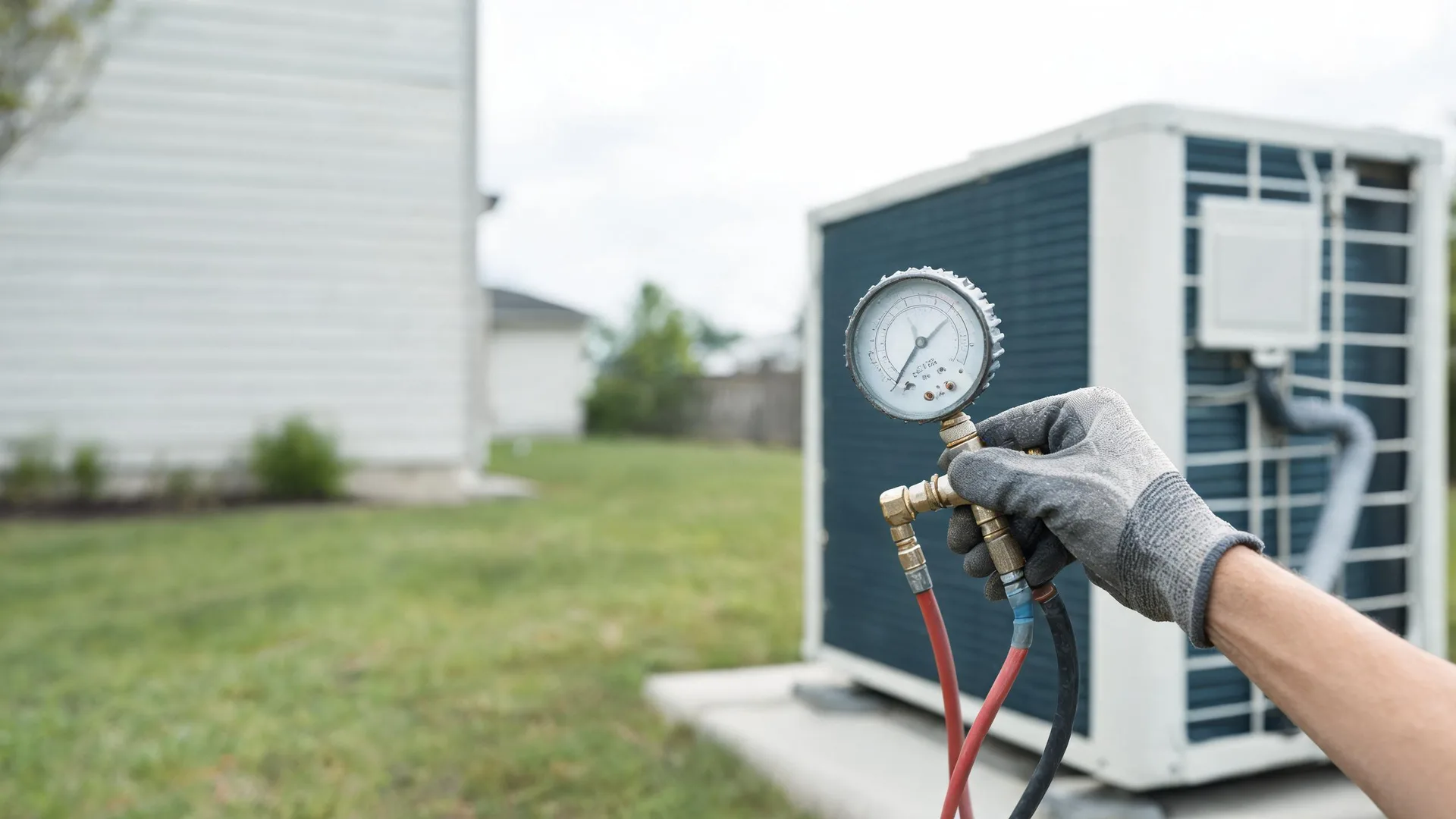
A diagnostic visit starts before any panel comes off. The tech asks what the system is doing, when it started, and what if anything changed around that time, because that points them toward certain parts and away from others. Then they'll check pressures and temperatures with gauges at the outdoor unit, pull the panel to look at the capacitor, contactor and wiring, and run the system through a cycle to see it fail in real time rather than take your word for it. Inside, they'll check airflow at the vents and look at the indoor coil if there's any sign of icing. A sharp eye and a multimeter find most problems faster than guessing from symptoms alone, and it's why a tech wants to see the unit running rather than just hear about it.