





A brick house with a white porch and a light-colored single-story house behind a trimmed hedge, framed by large oak branches draped with Spanish moss.

Heat Pump Repair in Hilton Head Island, SC

Tell us about the job

Takes about a minute. No obligation.

RepairHeat PumpBeaufort County, SC
Step 1 of 2

What ZIP code is the job in?

Most heat pump failures come down to a handful of parts. The reversing valve is a common one. It's what switches the system between heating and cooling, and when it sticks, the unit blows the wrong temperature air or gets stuck in one mode. A low refrigerant charge is another culprit, usually from a slow leak at a fitting or coil rather than the system just running low over time. Outside, the defrost sensor and control board work together to clear ice off the outdoor coil, and if either one fails, frost builds up and chokes off airflow. The capacitor that starts the compressor and fan motors wears out too, and when it goes, the unit might hum but not start, or not start at all.

5 months
November through March, your system heats
6 months
May through October, it cools
42°F
the average winter night it heats against
89°F
the average summer afternoon it cools against
Isometric illustration of a cutaway single-family house showing interior ductwork and an air handler, with an outdoor condenser unit connected by lines along the exterior wall.
Your system heats November through March and cools May through October.

NOAA nClimDiv, 1991–2020 normals

Beaufort County took damaging wind 304 times between 2015 and 2024.

A heat pump running through storms that often wears down its parts faster than the book says it should.

Heat pumps here earn their keep in November, and that's when a weak part gives out

Cooling runs May through October
Heat runs November through March
304 damaging wind events from 2015 to 2024

Half the homes in Beaufort County were built in 1999 or later. If yours is one of them, the heat pump may well be original, or close to it, and still worth repairing rather than replacing. A sticking reversing valve or a worn capacitor is a fixable problem, not proof the whole unit is at the end of its life, even on a system that has taken its share of storms. Age is still worth checking. Look at the data plate on the outdoor unit for the install date, since a newer house doesn't always mean a newer system if the heat pump was swapped out before you bought it.

Get it diagnosed properly

Your heat pump works hard here, and that's usually what's behind the problem. Have it diagnosed properly so the fix lasts.

Find a contractor
A man in a cap, gray shirt and tan work pants walks up steps toward a dark front door, carrying a worn canvas and leather tool bag, with a potted shrub to the right.
A gray heat pump outdoor unit mounted on a concrete pad next to a residential house with lap siding and stone accents.

304 storms between 2015 and 2024 means the diagnosis has to be specific

When a technician comes out after a storm season, have them check the parts most likely to have taken the hit. The capacitor, the reversing valve, the defrost control board. Wind that frequent can loosen panels, pack debris into the outdoor coil, or add a jolt from a power cut on top of whatever was already wearing thin. A proper diagnosis finds which part actually failed instead of swapping parts until something works.

A refrigerant leak doesn't hold still

A slow leak at a fitting or coil only gets worse while the compressor keeps pulling refrigerant through it. Running a heat pump low on charge also makes the compressor work harder to move heat, and that heat has nowhere to go but into the compressor itself.
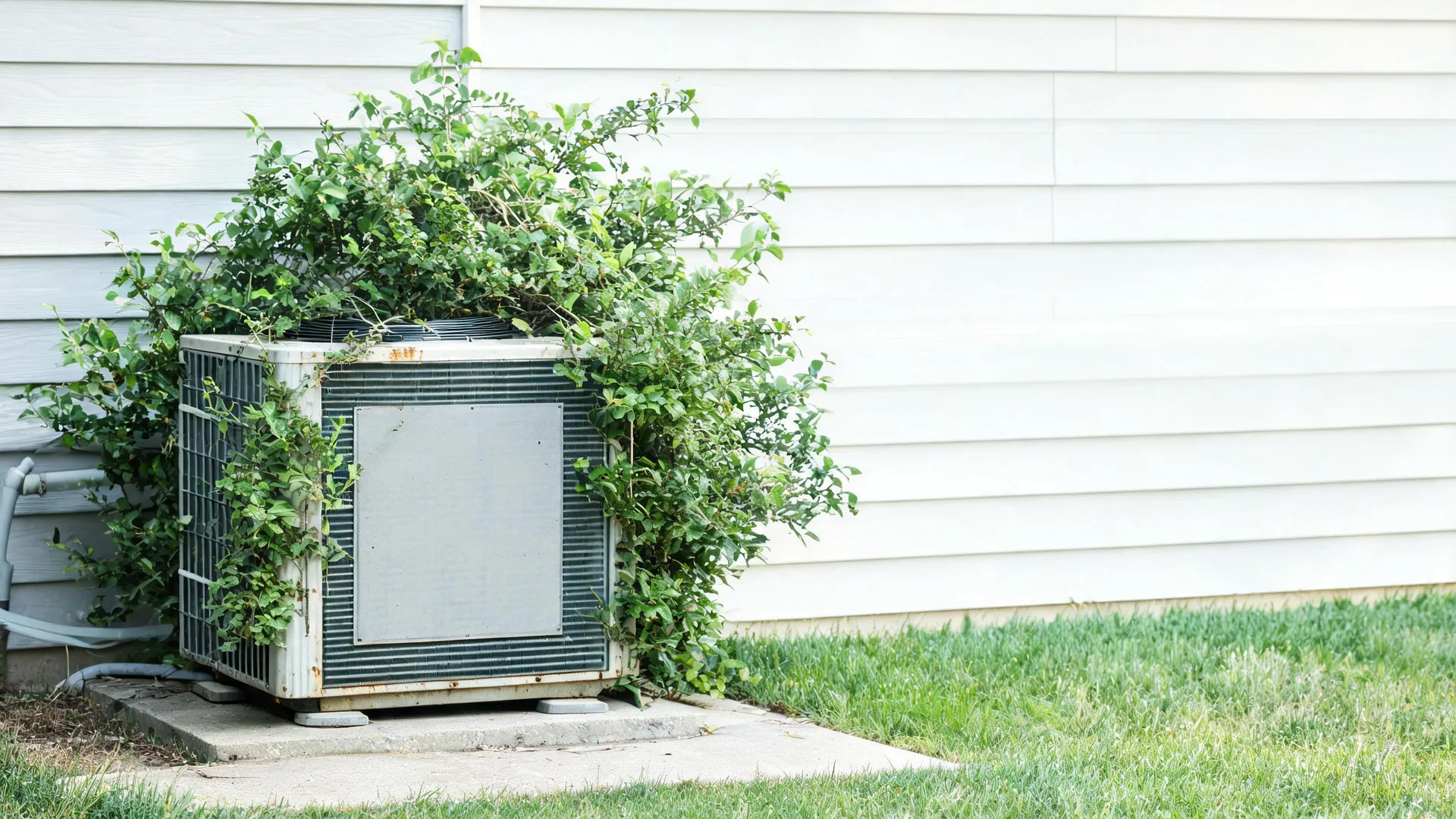
Frost spreads once it starts

When the defrost sensor or control board fails to clear the outdoor coil, the ice doesn't stay put. It builds across more of the coil each cycle, blocking airflow further and making the system run longer to get the same heat into the house.

A few things are worth checking before you call anyone out. Go to the thermostat first. Make sure it's set to heat and the temperature is actually above room temperature, since a setting bumped by accident looks exactly like a dead system. Check the breaker for the outdoor unit and the air handler, both, since either one tripping will shut the whole thing down. Look at the outdoor unit itself. If it's caked in ice outside of a normal defrost cycle, or it's buried in leaves and debris, that airflow problem is doing real damage the longer it sits. Inside, pull the filter and hold it up to the light. If you can't see through it, that's choking the system too, and it's the one fix you can do yourself for free.

Not every failure means a new unit. A part that fails on its own, like a capacitor or a defrost sensor, is a straightforward swap and the heat pump goes back to normal. What changes the math is the compressor. It's the most expensive part in the system, and when it fails outright, or when a long-ignored refrigerant leak takes it down with it, the repair bill starts competing with the cost of the whole outdoor unit. The other thing worth weighing is the pattern. One failed part is a repair. Different parts failing again and again over a short stretch is the system telling you it's worn out generally, not just unlucky in one spot. A technician who's honest with you will say which situation you're in instead of just quoting the fix sitting in front of them.