Night view of illuminated white Southern-style houses with wraparound porches beneath Spanish moss-draped oak trees.

Heat Pump Installation in Anderson, SC

Tell us about the job

Takes about a minute. No obligation.

New system or replacementHeat PumpAnderson County, SC
Step 1 of 2

What ZIP code is the job in?

Bigger isn't better

An oversized heat pump cools or heats the house fast, then shuts off before it pulls the moisture out of the air. The place ends up cold and clammy, and the compressor cycles on and off far more than it should, which wears it out faster than steady running would.

It comes from a room by room count

A contractor works out the right size with a load calculation, not the square footage of the old unit. They look at window area, insulation, ceiling height, and which way each room faces, then add it up room by room. A system sized off the house that's actually there runs longer, gentler cycles and keeps the temperature even from room to room.

5 months
November through March, your system heats
5 months
May through September, it cools
34°F
the average winter night it heats against
89°F
the average summer afternoon it cools against
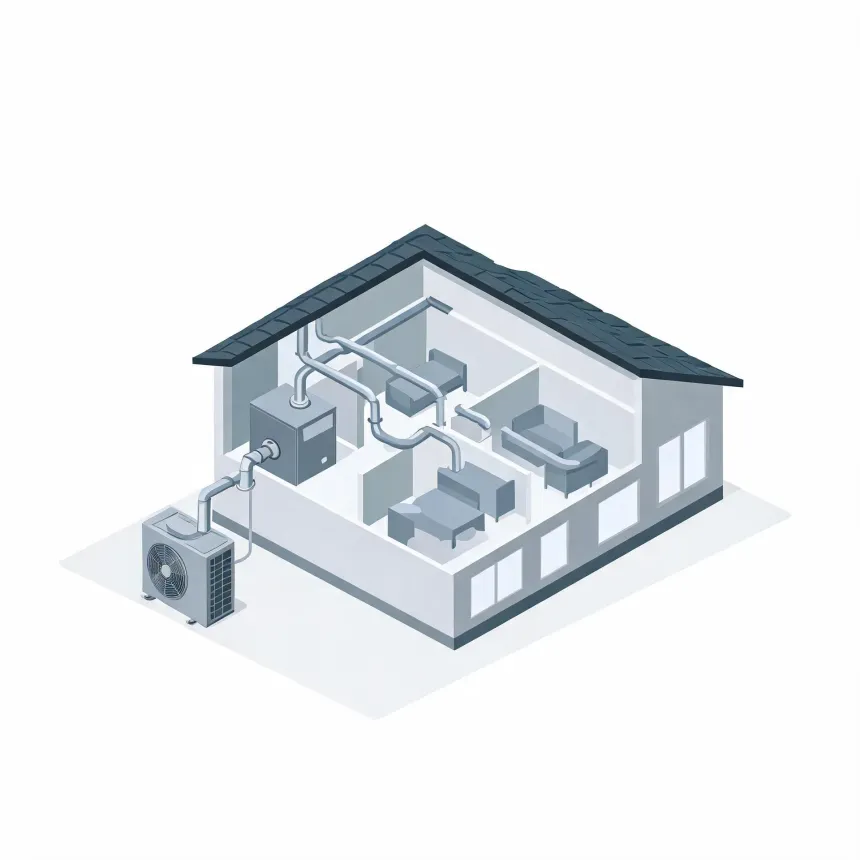
Isometric cutaway illustration of a single-story house showing an indoor air handler, branching ductwork through rooms with furniture, and an outdoor condenser unit connected by a line outside the wall.
Your system heats November through March and cools May through September.

NOAA nClimDiv, 1991–2020 normals

Electricity in South Carolina runs 14.23 cents per kilowatt-hour, below the national average.

A heat pump still earns its keep here, but the top-tier efficiency model takes longer to pay for itself, so pick yours on reliability and fit first.

Most homes here already run on electricity

64.4% of homes heat with electricity
111 damaging wind events from 2015 to 2024
33 hail events from 2015 to 2024
Have it in before NovemberHeat here starts in November, so October is the month to get it done.

With power this cheap, don't pay extra for the highest SEER2 number on the lot. Put that money into the installation instead. A unit matched to the right size, set up with a correct refrigerant charge, and paired with ductwork that doesn't leak will outperform a top-tier model installed carelessly. Ask the contractor what efficiency tier makes sense given local rates, and ask them to show the load calculation before you talk about brands. Fit and a clean installation are what keep the house comfortable and the system running for years.

What goes in has to meet South Carolina's minimum

Any heat pump installed here now has to hit 14.3 SEER2 and 7.5 HSPF2 at minimum, and the region's cooling demand pushes that same 14.3 SEER2 floor even higher than the national rule. That narrows what a contractor can legally put in. Ask what meets code here before you ask about brand.

Find a contractor
A dark gray heat pump unit mounted on a concrete pad next to a house with gray siding and a stone veneer wall.

The number on the label is a starting point, not a guarantee

That SEER2 and HSPF2 number on the label is a lab result, not a promise. It's measured at a fixed set of conditions, cycling the same way every time. Run the system for years, through real heat and real cold, and the number drifts from what's stamped on the box. A dirty coil, a low refrigerant charge, a blower working harder than it should all pull actual performance below the rated figure. None of that shows up on the label, only in the power bill and in how long the compressor runs to hit the thermostat setting. The rating tells you what the equipment is capable of brand new and clean. What you get over the life of the system depends on the charge being set right at install and the coil and filter being kept clean after that.

The equipment is the smaller cost

The heat pump and air handler are only part of the bill. Line sets, a new disconnect, pad work, and whatever the electrical panel needs to carry the load all add up, and that work depends on what's already there. A straightforward swap where the old lines and panel capacity still work costs less than a job where the installer has to run new wire or upsize the panel to handle the new unit.

Ductwork decides more than the unit does

A heat pump moves a different volume of air than a furnace system, often at lower temperatures for longer stretches. Ducts sized for the old equipment may choke the new one or leak air into the attic before it reaches the room. Sealing or resizing ductwork is where an installation can grow, but skipping it leaves the new system working against the house instead of with it.

The old system doesn't get left in place. Whatever's tied to the house, the line set, the pad, the electrical whip, gets disconnected before the new equipment goes in. A gas furnace paired with the old unit may need capping off if the heat pump is replacing it outright. The refrigerant in the old coil has to be recovered properly rather than vented, that's a legal requirement, not a courtesy. If the old equipment used a different refrigerant than what's made today, that recovery step matters even more. Once it's disconnected, the old condenser and air handler get hauled off, and the new pad and lines go in clean rather than built around what was already there.

Install day starts with the ductwork and electrical already sorted, so the actual equipment swap moves fast. The new line sets get brazed and pressure tested before anything is charged with refrigerant, and that pressure test has to hold before the installer moves on. Once the indoor and outdoor units are set, the system gets charged to the manufacturer's spec for the line length and the conditions that day, not just topped off by feel. A vacuum pulls any moisture and air out of the lines first, because either one left behind will damage the compressor over time. Then the installer runs the system, checks the temperature split at the vents, and confirms the charge is right rather than close. The last part of the day is explaining the thermostat and what the system needs going forward, not just handing over a manual and leaving.