






Two illuminated white Southern-style houses with wraparound porches and staircases, framed by a Spanish moss-draped tree on a quiet street at night.

Heat Pump Installation in Marion, SC

Tell us about the job

Takes about a minute. No obligation.

New system or replacementHeat PumpMarion County, SC
Step 1 of 2

What ZIP code is the job in?

Electricity in South Carolina runs about 14.23 cents a kilowatt-hour, cheaper than a lot of the country. That changes the math on a heat pump. The top-efficiency models cost more up front and take longer to earn that back when power is already cheap here. A mid-tier heat pump that holds up through a hard freeze or runs reliably after the power's been out matters more than squeezing out another point of efficiency. Talk to the installer about what handles Marion's weather well before you pay extra for a rating you may never recoup.

5 months
November through March, your system heats
5 months
May through September, it cools
36°F
the average winter night it heats against
90°F
the average summer afternoon it cools against
Isometric line illustration of a cutaway single-story house showing interior rooms with ducted air distribution, an indoor air handler, furniture, and an outdoor condenser unit connected by lines outside the wall.
Your system heats November through March and cools May through September.

NOAA nClimDiv, 1991–2020 normals

A heat pump installed here runs heat from November through March.

Have it in before October ends, so the first cold night isn't the night you find out something's wrong.

A standard size and efficiency holds up fine here

Half the homes here were built by 1982
Power costs 14.23 cents a kWh statewide
Climate zone 3A

Electricity already heats 86 percent of homes in Marion County. A heat pump fits right into that, since it runs on the same power most houses are already wired for. Gas heat is rare here, just 7.5 percent, and LP gas covers another 4.7 percent. That means most homeowners replacing a system aren't switching fuels or rerouting anything, just putting in a new heat pump where the old electric system was. It's the straightforward path for most houses in the county.

A new system here starts at the regional minimum, not the national one

Any heat pump installed here now has to hit 14.3 SEER2 and 7.5 HSPF2 at minimum. That floor is already built into what installers are offering, so you won't find anything below it on the market. There's also a federal tax credit available for qualifying heat pumps, worth asking your installer about before you settle on a model.

Find a contractor
A man in a navy long-sleeve shirt and tan pants carries a canvas tool bag up concrete steps toward a dark blue front door flanked by columns and a potted shrub.
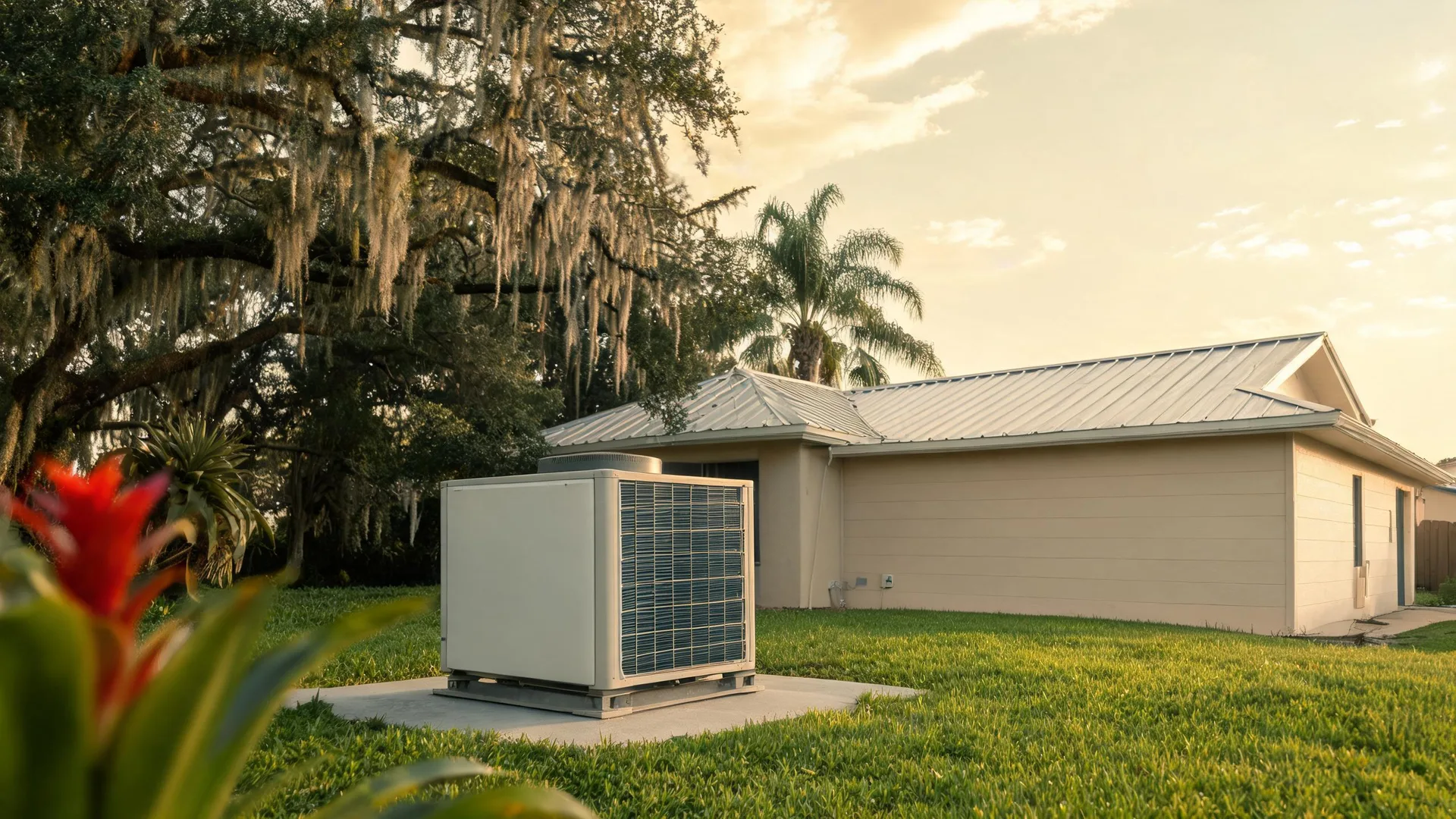
A gray heat pump condenser unit mounted on a concrete pad against the gray lap-siding exterior wall of a house.

The label describes the equipment, not how it runs in your house

The rating on the label tells you how much heat a system moves for the electricity it puts in, averaged over a full season of running rather than one mild afternoon. It assumes the ductwork moves air the way it should and the charge is right. A system with a strong rating on paper can still run worse than that in practice if the coil is dirty or the airflow is restricted, since the label describes the equipment, not the installation. That rating also isn't fixed once the system is running. A refrigerant leak or a clogged filter drags down the efficiency you actually get, no matter what the label says. Think of the number as what the system is capable of when everything around it is working right, not a promise of what you'll see on the power bill.

Your old system gets disconnected and hauled off

The installer disconnects the old unit from the electrical circuit and, if it's a split system, recovers the refrigerant from the lines before anything gets removed. Refrigerant can't legally be vented into the air, so it gets pulled out with a recovery machine first. After that the indoor and outdoor units come out, along with the old line set if it's not being reused. A straightforward swap like this usually doesn't take installers more than a day.
The refrigerant lines usually get replaced, not reused

Old line sets often have the wrong diameter or leftover oil that doesn't mix with the new system's refrigerant, so most installers run new copper rather than tie into what's there. That means some patching where the old lines passed through the wall or slab. If the ductwork and electrical disconnect are already in good shape, those typically stay as they are, since a heat pump swap doesn't usually call for touching either one.

When you're comparing quotes, ask what size unit each installer is proposing and how they landed on it. It should come from a load calculation done for your house, the windows, the insulation, the square footage, not a rule of thumb based on the old system's size. A unit that's too big cycles on and off fast and never runs long enough to dehumidify properly. One that's too small runs constantly and still can't keep up on the coldest nights. Ask what happens below freezing, specifically whether the system leans on backup heat strips and at what temperature it switches over, since that's where your running cost actually shows up. Ask about the warranty on the compressor versus the labor, because those are often different lengths, and a long parts warranty doesn't help you if the labor to replace that part isn't covered. And ask who's doing the startup, the refrigerant charge, the airflow check, since a system installed carelessly won't hit the numbers on its label no matter how good the equipment is.

Installation day starts with the old system coming out and doesn't move fast after that. Once the new outdoor unit and air handler are set, the installer pulls a vacuum on the line set to clear out moisture and air before any refrigerant goes in, and that step alone can take a while if there's a leak holding the vacuum back. Then comes the charge, weighed in against what the manufacturer specifies for that line length, not just run until the gauges look about right. After that, the electrical gets tied in and the system gets its first startup, where the installer checks airflow across the coil, confirms the thermostat is talking to the right stages, and runs the system in both heating and cooling before calling it done. A rushed startup is where problems hide, since a system can run and still be charged wrong or starved for air, and you won't see it on a label or a thermostat screen. Ask whatever you don't understand while the installer's still there, since that's easier than troubleshooting it later.