A illuminated white antebellum-style house with a wraparound porch, white columns, and Spanish-moss-draped oak trees, photographed at dusk.

Heat Pump Installation in Camden, SC

Tell us about the job

Takes about a minute. No obligation.

New system or replacementHeat PumpKershaw County, SC
Step 1 of 2

What ZIP code is the job in?

The rating is a lab number, not a promise

The efficiency rating on a heat pump is measured under set lab conditions, not in your house. It tells you how the equipment compares to other equipment, not what your actual bills will look like. Ductwork, insulation, and how the system gets sized and installed all affect real performance as much as the number on the label does.


A higher rating changes the equipment, not just the price

Higher-rated heat pumps often use a variable-speed compressor instead of a single-speed one, which lets the system run longer at lower output rather than cycling on and off. That tends to mean steadier temperatures and quieter operation, but it also means more electronics that can need service down the road. Worth asking what's actually driving the higher number on any unit you're comparing.

5 months
November through March, your system heats
5 months
May through September, it cools
34°F
the average winter night it heats against
90°F
the average summer afternoon it cools against
Isometric line illustration of a cutaway single-story house showing interior ductwork, an indoor air handler unit, and an outdoor condenser connected by refrigerant lines, with a dark shingled roof.
Your system heats November through March and cools May through September.

NOAA nClimDiv, 1991–2020 normals

Electricity in South Carolina runs 14.23 cents per kilowatt-hour, below what most of the country pays.

A top-tier heat pump takes longer to earn back its extra cost here, so pick one for how it holds up through a Camden summer, not just for the rating on the label.

Put it in before November, and before May, not during either one

Cooling runs May through September
Heat runs November through March
116 damaging wind events from 2015 to 2024

Electricity heats 71.5% of homes in Kershaw County, far more than gas or anything else. That's already a heat pump or straight electric resistance in most houses here, so putting in a heat pump usually means working with wiring and a system layout that's already set up for it, not starting from scratch. Gas heat only reaches a fifth of homes here, and propane trails behind that. If your place already runs on electric heat, a heat pump replacement is a more direct swap than people expect.

Any new system here has to clear South Carolina's higher bar

Kershaw County falls under the Southeast's stricter rule, not just the national one. A new split-system heat pump has to hit at least 14.3 SEER2 and 7.5 HSPF2, and a central air conditioner needs 14.3 SEER2 below 45,000 Btu/h. That narrows what a contractor can install here, and it's worth confirming on anything you're quoted. A federal tax credit is also available on qualifying equipment this year.

Find a contractor
A man seen from behind in a dark sweatshirt and tan work pants climbs porch steps toward a gray paneled front door, carrying a canvas tool bag in his right hand, with a potted shrub to the left.
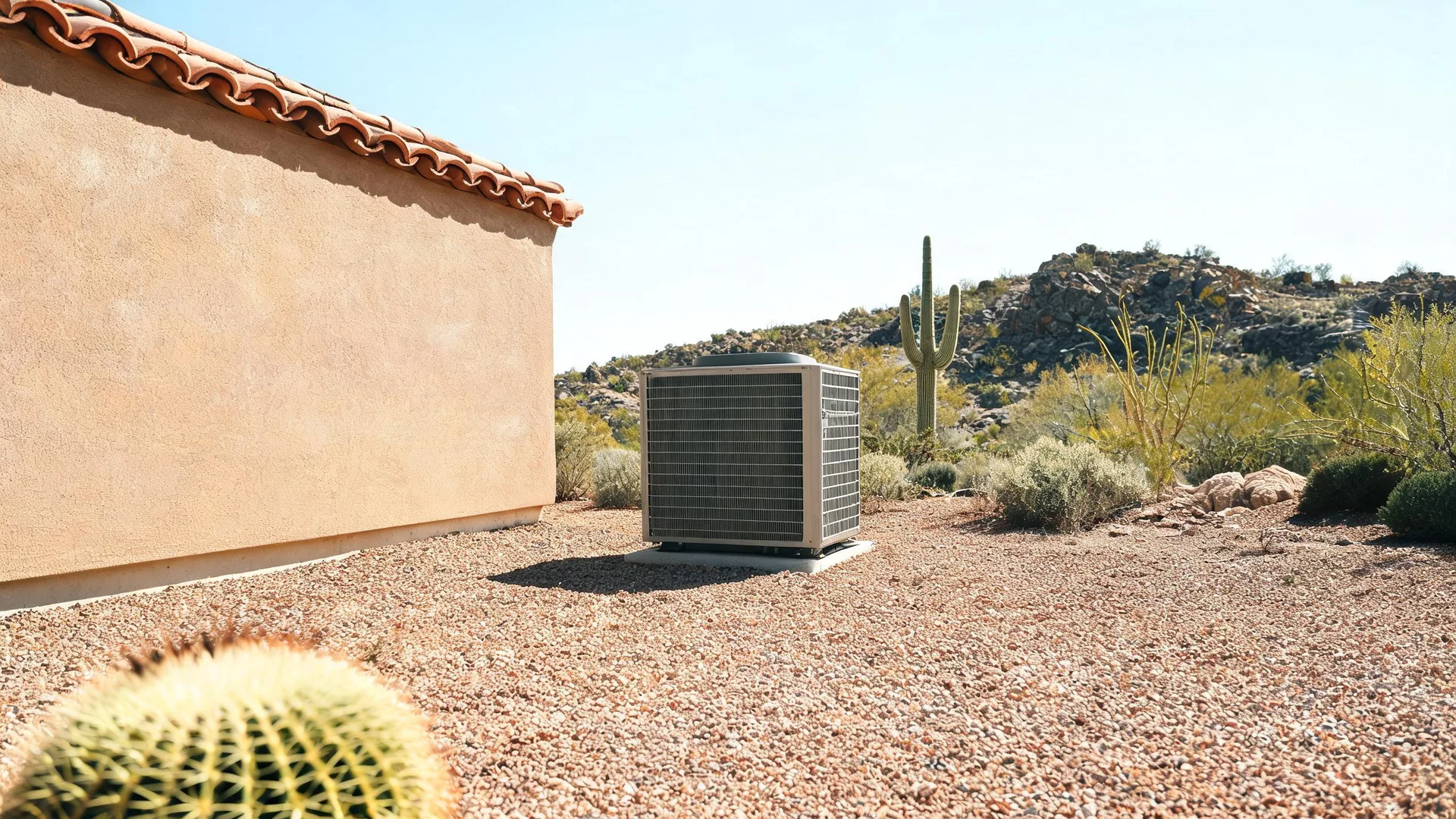
A white mini-split heat pump outdoor unit mounted on a concrete pad beside a gray-sided house, surrounded by gravel and green shrubs.

It runs year-round here, and that's not the issue

A heat pump here runs through winter and summer both. It doesn't get a long stretch of standing idle like a furnace-only system would. That's normal duty for this kind of equipment, not a strain on it. Wind is the bigger factor in Kershaw County. Damaging wind hit the county 116 times between 2015 and 2024, enough to knock out power on a regular basis. A standard heat pump sized right for the house handles that fine once power comes back. The outdoor unit just picks up where it left off. Nothing about the hours this machine logs here calls for oversizing it or stepping up to a higher tier than the house needs.

Sizing comes from a room by room heat loss and heat gain calculation, not the old unit's label

A contractor measures the house, the windows, the insulation levels, and the orientation of each room to work out how much heat it loses in winter and gains in summer. That number, not whatever size the last system happened to be, is what the new heat pump gets sized to. Houses that look alike from the street can still need different sized equipment once someone actually runs the numbers.

Oversized and undersized both cause problems, just different ones

A heat pump too big for the house cools or heats the air fast, shuts off, and starts again soon after, so it never runs long enough to pull moisture out of the air or settle into steady output. One too small runs constantly and still can't keep up on the coldest or hottest days, leaning hard on backup heat strips instead. The right size runs in long, steady stretches instead of short bursts or constant strain.

Taking out the old equipment is part of the job, not an afterthought. The indoor and outdoor units both get disconnected, and the refrigerant in the old system has to be recovered into a tank rather than vented, that's a legal requirement, not a courtesy. Whoever pulls the system should be able to tell you where that refrigerant is going. The old line set usually comes out too, since new equipment rarely matches up with it cleanly, and reusing it can carry contamination into the new system. If the old unit ran on electric resistance backup or shares a disconnect box with the new one, that wiring gets checked against what the new heat pump actually needs rather than left as is. None of this is the dramatic part of an install, but skipping it is how a new system inherits an old problem.

Install day starts with the power cut at the breaker before anyone touches the old equipment. From there it's a sequence, not a scramble. Once the old system is out and the new line set and wiring are in, the outdoor unit gets set on its pad and the indoor coil goes in next to the furnace or air handler. The line set gets connected and pressure tested for leaks before any refrigerant goes in. Finding a leak after the system is charged means recovering that charge and starting over, so the test happens first. The system then gets charged to spec, not just topped off by feel. Last comes startup, checking refrigerant pressures, airflow, and that the thermostat is actually talking to the equipment before anyone calls the job done.