A red brick wall with a row of low shrubs and mulch bed on the left, a mown lawn in the center, and a single-story light-colored house with a gabled roof beyond, backed by pine trees under an overcast sky.

Heat Pump Installation in Aiken, SC

Tell us about the job

Takes about a minute. No obligation.

New system or replacementHeat PumpAiken County, SC
Step 1 of 2

What ZIP code is the job in?

Minimum efficiency is set by the Southeast

A heat pump installed here has to meet 14.3 SEER2 for cooling and 7.5 HSPF2 for heating. Aiken County falls in zone 3A, and the Southeast standard is already higher than what the rest of the country requires.

That narrows what a contractor can install

Any system a contractor quotes for this job has to clear that regional minimum, not just the national one. It cuts out older or lower-tier equipment that might still be legal to install elsewhere.

5 months
November through March, your system heats
5 months
May through September, it cools
36°F
the average winter night it heats against
91°F
the average summer afternoon it cools against
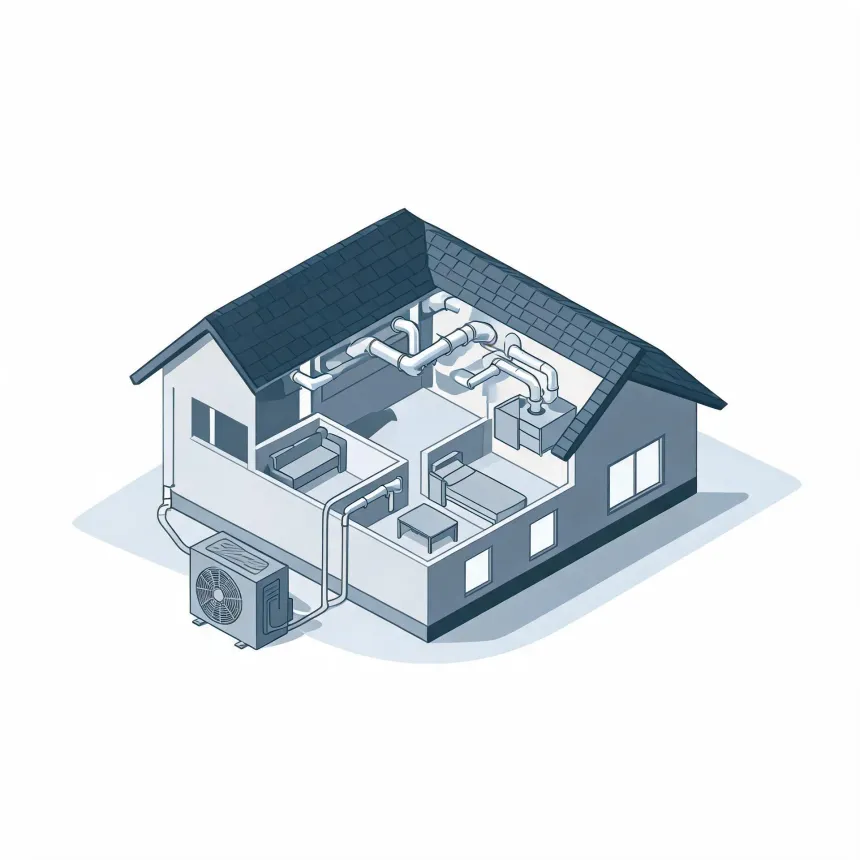
Isometric cutaway illustration of a house showing attic ductwork, an indoor air handler, furnished rooms, and an outdoor condenser unit connected by lines along the exterior wall.
Your system heats November through March and cools May through September.

NOAA nClimDiv, 1991–2020 normals

A heat pump sized by square footage alone is often wrong for the house it's going into.

The contractor has to run a load calculation, room by room, before any unit gets picked.

Most homes in Aiken County already run on electricity

63.6% of homes heat with electricity
185 damaging wind events from 2015 to 2024
52 hail events from 2015 to 2024

Electricity in South Carolina runs 14.23 cents per kilowatthour, below what most of the country pays. That changes the math on a heat pump. A higher-SEER2 unit still uses less power than a lower one, but at this rate it takes longer to earn back the difference in cost. That doesn't make efficiency pointless, it means it shouldn't be the only thing driving the choice. How well the unit holds up through a bad summer or a hard freeze, and how well it was sized for the house, counts for more here than squeezing out another point of SEER2.

Install before the season needs it

Heat pumps installed here run heat from November through March and cooling from May through September. Get it in during April or October and the install happens on your schedule, before the system has to carry the next season's load.

Find a contractor
A man seen from behind in a dark shirt and tan work pants carries a canvas tool bag up stone steps toward a gray panelled front door of a shingled house, with a potted shrub beside the entry.
A gray heat pump condenser unit mounted on a concrete pad against the gray lap-siding exterior wall of a house.

The label tells you the ceiling, not what you'll get

The SEER2 and HSPF2 numbers on the label are a ceiling, not a promise. They're measured in a lab, at a fixed temperature, with the unit running clean and the airflow exactly where it should be. Once that heat pump sits outside through its first heavy pollen season or the first stretch of hard freezes, actual performance drifts from that number. A dirty outdoor coil or a filter nobody's changed pulls real efficiency down no matter what the label says. The rating matters most as a way to compare one unit against another before it's installed. After that, how it's maintained does more to decide what it actually costs you to run than the number stamped on the side of it.

The old unit doesn't just get unplugged

A contractor has to recover the refrigerant from the old system before any of it comes apart. That gas can't be vented into the air, it has to be pulled out with a recovery machine and kept in its own tank. Only after that's done does the old condenser and air handler actually come out.

The new unit may not reuse what the old one left behind

The line set, the pad, the electrical disconnect, sometimes the ductwork itself, all of it gets checked against what the new heat pump needs. A line set sized for the old system's refrigerant charge can be the wrong diameter for the new one. Reusing a pad or a disconnect is fine when it still fits. Forcing the new unit onto parts it wasn't matched to is how a new install ends up running poorly from day one.

What drives the price is how much the installation has to change, not just the equipment sitting on the pad. A straight swap, same spot, same line set, same ductwork, same electrical, costs less because there's less to touch. The moment any of that doesn't match what the new heat pump needs, the job grows. A line set that's the wrong diameter has to be replaced. A disconnect or breaker sized for the old unit may not carry the new one. Ductwork that was never quite right for the house gets exposed once a properly sized system is pushing air through it. None of that shows up on the heat pump's price tag, but all of it shows up on the invoice.

Installation day starts before anyone touches the old unit, with the power shut off and the system checked against the plan drawn up from the load calculation. Refrigerant recovery comes first, then the old condenser and air handler come out. Setting the new unit means getting the pad level and the line set run clean, with good connections at both ends, because a poor brazing joint or a kinked line is where a refrigerant leak shows up years later. Once it's set, a contractor pulls a vacuum on the line set to clear out moisture and air before any refrigerant goes in. That vacuum has to hold, if it doesn't, there's a leak somewhere that needs fixing before the system gets charged. After startup, the technician checks refrigerant charge, airflow across the coil, and that the thermostat is actually talking to the unit the way it should. A heat pump that's wired and charged right runs quiet from the first cycle, nothing about the first day should feel like a test.