





An unfinished concrete basement containing a metal HVAC air handler, exposed wooden ceiling joists with sheet-metal ducts, a hanging bare bulb, copper pipes, and stacked cardboard boxes.

Furnace Repair in Goose Creek, SC

Tell us about the job

Takes about a minute. No obligation.

RepairFurnace or heatingBerkeley County, SC
Step 1 of 2

What ZIP code is the job in?

Most furnace trouble comes down to a handful of parts. The igniter wears out from heating and cooling every cycle, and once it cracks the furnace won't light at all. A flame sensor coated with residue tells the control board no flame is present, so the system shuts itself down even though it's working fine otherwise. Dirty filters cause a lot of the rest. Airflow drops, the heat exchanger overheats, and the limit switch trips to keep the furnace from damaging itself. Capacitors on the blower motor weaken over the years until the motor struggles to start or stops turning the way it should. Some of this is wear you can't avoid, and some of it is easy to head off with a filter change on schedule.

5 months
November through March, your furnace is on duty
38°F
the average winter night it heats against
2 winter storms
in ten years, the nights a failure hurts most
Isometric grayscale illustration of a cutaway single-story house showing interior rooms with furniture, a furnace unit connected to ductwork and a tall vertical flue pipe extending above the roof.
Your furnace works hardest from November through March.

NOAA nClimDiv, 1991–2020 normals

A furnace that short cycles, turning on and off before the house warms up, is usually protecting itself from something.

Find the cause now and it's a small fix. Wait, and the limit switch or heat exchanger takes the damage instead.

Five months of heat a year means this furnace isn't worn out, it's just old or neglected

Heat runs November through March
Winter nights average 38°F
Climate zone 3A

Nothing about a Goose Creek winter asks more of a furnace than what it was built for. The failures above show up here the same way they show up anywhere else. An igniter cycles on and off enough times and cracks. A flame sensor collects enough residue to fool the control board. A filter goes too long without a change. Electricity here runs $41.71 per million Btu, so when a capacitor weakens and the blower motor has to strain to start, that strain shows up on the bill before it shows up as a failure. None of this points to anything unusual about the area. It points to a part that wore out doing its normal job, and a repair that fixes the part.

A newer furnace is worth fixing, not swapping out

Half the homes in Berkeley County were built in 2002 or later. If that includes yours, the furnace behind the failure likely isn't old. It's a part that wore out on a system with good years left in it, and that's a repair, not a replacement.

Find a contractor
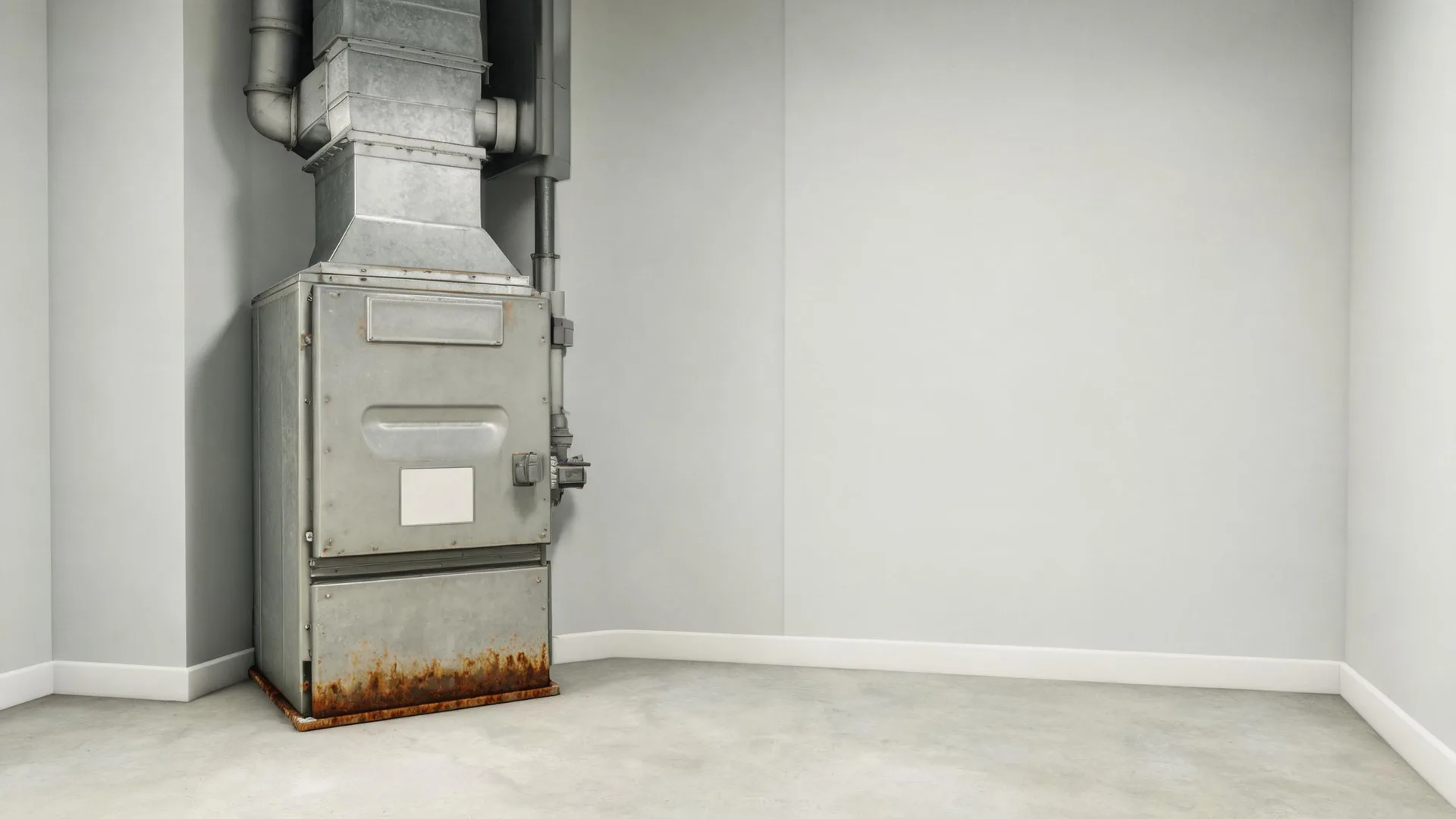
A gray residential gas furnace installed in an unfinished basement, surrounded by ductwork, a metal flue pipe, and a gas supply line.

Check the age before you replace anything

If your furnace came with the house, check the paperwork before you assume the worst. A cracked igniter or a weak capacitor on a system from 2002 or later isn't a sign the furnace is done. It's a sign one part gave out. Have the technician replace the part and move on.

A cracked heat exchanger gets worse with every cycle

Heat makes metal expand, and a hairline crack opens a little wider each time the furnace fires. Left alone, it can let exhaust mix into the air the blower pushes through the house. That's not a wait and see problem.
A struggling blower motor can burn itself out

Once a capacitor weakens, the motor draws more current trying to start and run. Keep calling on it and the windings overheat. A part that would have been a simple swap turns into a motor replacement.

Before you call anyone, check the thermostat is set to heat and the setting is above room temperature. Go to the furnace and make sure the switch on or near it, the one that looks like a light switch, is on. Check the filter. If you can't see light through it, that alone can cause a shutdown or a short cycle. Look at the breaker for the furnace and the fuel supply if you use gas or propane, since either one being cut off stops the furnace cold. If you have an older furnace with a standing pilot, check whether the pilot light is lit. None of this takes tools, and it rules out the causes that aren't actually a repair.

A diagnostic starts before any panel comes off. The technician asks what the furnace was doing right before it quit, since a system that short cycled is a different problem than one that won't light at all. Then the covers come off and the igniter gets a look, because a cracked igniter is often visible without a single test. The flame sensor gets checked next, and if it's coated, cleaning it is usually enough to tell whether that was the whole problem. Airflow gets checked too, starting with the filter, since weak airflow is behind a lot of limit switch trips. Only after those get ruled out does the technician move to the blower motor and capacitor, testing whether the motor is pulling more current than it should. The goal on this visit isn't to replace parts until something works. It's to find the one part actually causing the failure and leave the rest alone.